Amazon Deals

New at Amazon

Friday, June 29, 2018

How tree trunks are cut to produce lumber with different shapes, grains, and uses

In the category of "things to which I've given zero thought", the complexity of this topic surprised me - I'll probably never learn much more about it, but some of you may be inspired to do so:
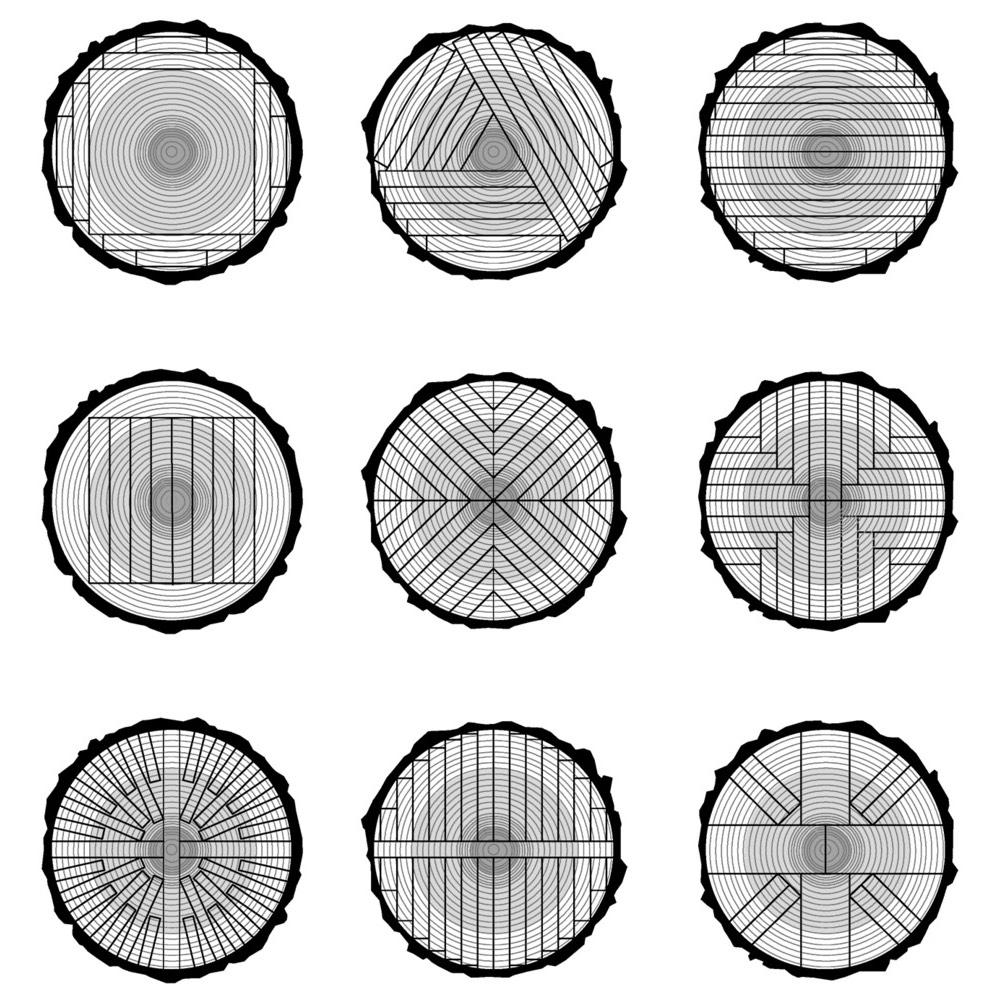

The lumber we use to build is extracted from the trunks of more than 2000 tree species worldwide, each with different densities and humidity levels. In addition to these factors, the way in which the trunk is cut establishes the functionality and final characteristics of each wood section. Let’s review the most-used cuts.
Each cut pattern produces wood with grain patterns and composition that makes it more or less suited to particular uses. For instance, the “interlocked cut” produces thin boards that are “quite resistant to deformation”.
Although these techniques may differ depending on the use required, there are three main ways to cut a log into boards: Rift, Quarter and Flat Sawn- and a series of variations that arise from them:

Rift sawn
Rift Sawn

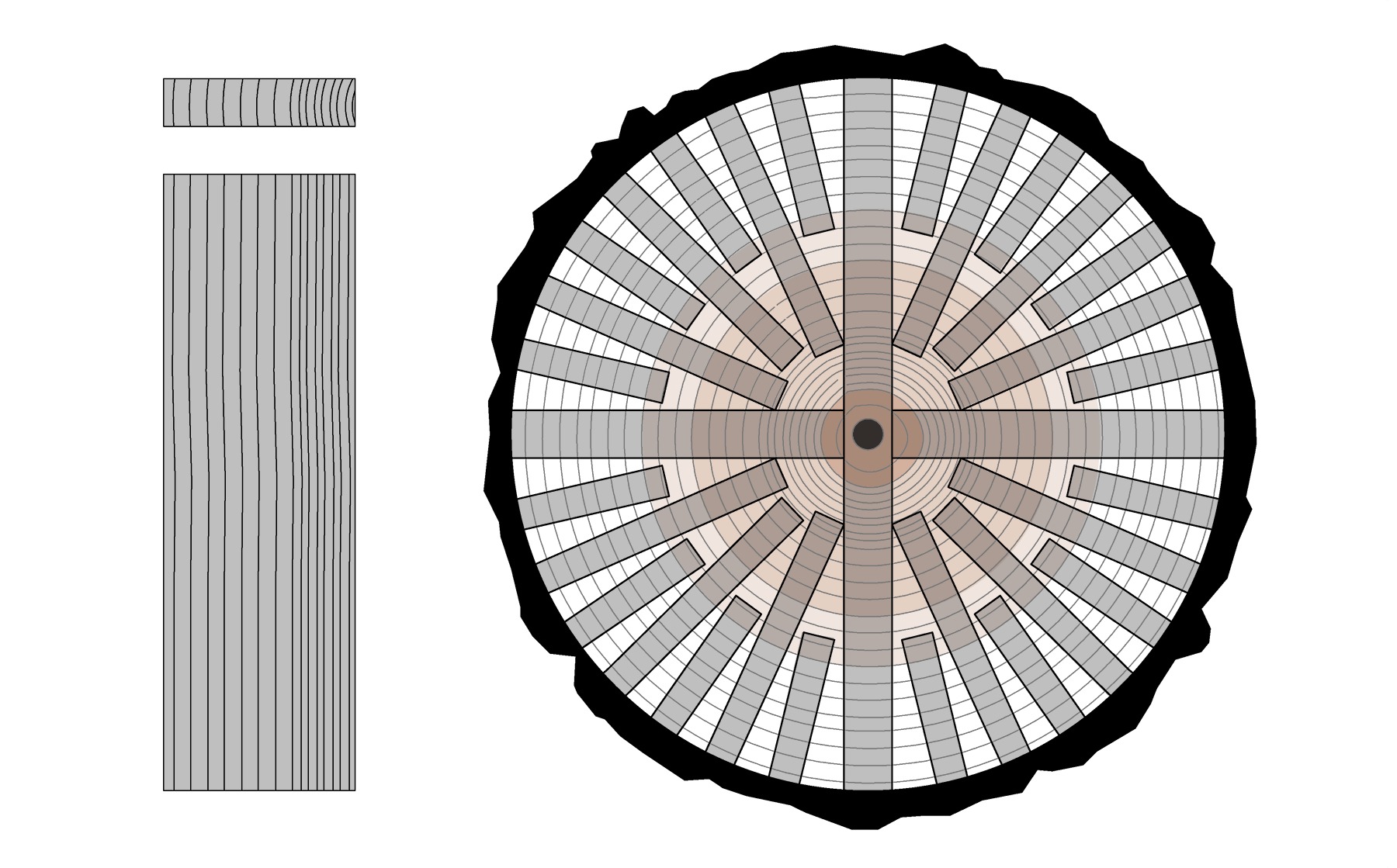
This cut is made perpendicular to the growth rings. It keeps the wood grain visible and avoids warping (deformations in the shape of the board) or fissures (longitudinal cracks), but wastes more material than other cut types.

Quarter Sawn

Cuts are made parallel to the four axes of the trunk, obtaining pieces that are not too prone to warping with a large number of visible rings.

Flat Sawn/Live Sawn

This is a widely used method, although the resulting pieces are not of the best quality since most include a certain percentage of the Sapwood and the Heartwood. The centerpiece that coincides with the core can tend to break, while the remaining pieces are prone to warp and curl.
Much more at Arch Daily, via Kottke.

Friday links

June 30, 1934 was the Night of the Long Knives, Hitler's purge of those standing in his way.

How the Second World War Made America Literate.

News you can use: How To Tell If You've Been Abducted By Aliens.

How tree trunks are cut to produce lumber with different shapes, grains, and uses.


Dancing at the Lunatic’s Ball at the  New York City Lunatic Asylum on Blackwell’s Island.

ICYMI, Thursday's links are here, and include DARPA's re-invention of the wheel, DIY V-steaming instructions, chocolate chip cookie science, and the anniversary of both the event that started World War One and the treaty that ended it.

Thursday, June 28, 2018

Thursday links

June 28 is the anniversary of both the event that started (the assassination of Archduke Franz Ferdinand of Austria and his wife - heirs to the Austrian throne) and the treaty that ended World War One


DARPA Literally Reinvented the Wheel.

Want your vagina steam-cleaned but don't have a spa nearby? Here are the do-it-yourself instructions.

WHO (World Health Organization) warns you not to drink camel urine.

Bake the Best Chocolate Chip Cookies by Knowing What to Tweak.

ICYMI, Wednesday's links are here, and include Helen Keller's birthday, the science of colorful monkey butts (and a gallery), the new supervolcano is brewing under New England. and the taxpayer funding behind Domino's Extra Cheesy Pizza. 

Wednesday, June 27, 2018

June 28 is the anniversary of both the event that started and the treaty that ended World War One

June 28 is the anniversary of two days that might be said to mark the beginning and end of the First World War. It's the anniversary of the assassination of Archduke Franz Ferdinand (wiki) of Austria and his wife - heirs to the Austrian throne - by Serbian radical Gavrilo Princip on June 28, 1914, the proximate cause of the beginning of the war. If you're interested in further information on the subject there are hundreds of books and films - the best books I know of (and I'm no expert) are Barbara Tuchman's The Guns of August (this won a Pulitzer back when they meant something) and John Keegan's The First World War.

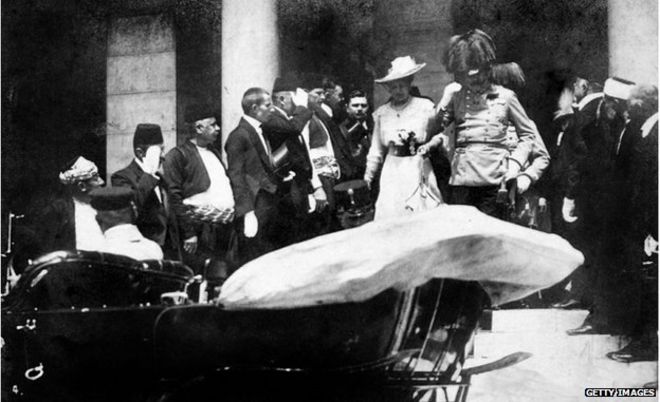
Franz Ferdinand and his wife Sophie at Sarajevo - The German caption
 says, "Leaving the town hall, 5 minutes before the assassination":
On the same date in 1919, five years later, the peace treaty that ended the war was signed in the Hall of Mirrors at Versailles. In the interim, ten million died, twice that number were wounded, and Europe's late-19th-century faith in the inevitability of progress and human betterment was destroyed. On hearing the terms of the Versailles Treaty (wiki), Germany's much-maligned Kaiser Wilhelm II noted from exile that, 

"The war to end war has resulted in a peace to end peace,"

and France's Marshall Ferdinand Foch observed,

"This is not peace; it is an armistice for twenty years." 

They were right.

God grant we may not have a European war thrust upon us, and for such a stupid reason too, no I don't mean stupid, but to have to go to war on account of tiresome Servia beggars belief. 

~ Mary, Queen-Consort of England's George V (letter to her aunt, Princess Augusta of Mecklenburg-Strelitz, 28 July 1914) 

The lamps are going out all over Europe; we shall not see them lit again in our lifetime. 

~ Sir Edward Grey (remark, 3 August 1914, on the eve of Britain's declaration of war) 

The War was decided in the first twenty days of fighting, and all that happened afterwards consisted of battles which, however formidable and devastating, were but desperate and vain appeals against the decision of Fate. 

~ Sir Winston Churchill (Preface to Spears, Liaison 1914) 

When every autumn people said it could not last through the winter, and when every spring there was still no end in sight, only the hope that out of it all some good would accrue to mankind kept men and nations fighting. When at last it was over, the war had many diverse results and one dominant one transcending all others: disillusion. 

~Barbara Tuchman (The Guns of August, "Afterward") 

This animated map reflects the daily changes over the course of the war:


Here's a 6 minute overview of World War I:


And the BBC’s Horrible Histories explanation of how the Brits got involved:

The Atlantic has a series of photoessays entitled World War I in Photos on various WWI topics.


An 8 minute video on The Treaty of Versailles and its consequences:


Previous posts: Wilfred Owen, the best of the WWI "War Poets", was born 121 years ago today

Wednesday links

June 27 is Helen Keller's birthday: here are quotes, links, some history, and a selection of (non-PC) jokes.

The taxpayer funding behind Domino's Extra Cheesy Pizza. Kind of related: How Domino's Pizza Lost Its Mascot.

Synthetic Street USA was a fake, part of the camouflage that covered the B17 Bomber factory in Seattle during WWII.

Anoint the gums with the brains of a hare: advice from c. 1450 on soothing a teething baby. Apparently dog milk works, too.

Science: Why Are Monkey Butts So Colorful? Includes a gallery of colorful monkey butts.


ICYMI, Tuesday's links are here, and include the survival uses for tampons and condoms, that time the U.S. Navy built a battleship in New York City's Union Square, a supercut of movie characters getting angry and flipping over tables, and an interactive map showing where your house would have been 750 million years ago.